Showing posts with label buddhist. Show all posts

Saturday, April 26, 2014

Cambodian Apsaras (अप्सराः), Devatas & Gods

My last post from my trip to Cambodia last Christmas. Gods, devatas and apsaras fill your senses and you consciousness when you visit the temples of Angkor. Here's a few shots of these wondrous forms.
Beautifully adorned multi-armed form of Vishnu in Angkor Wat

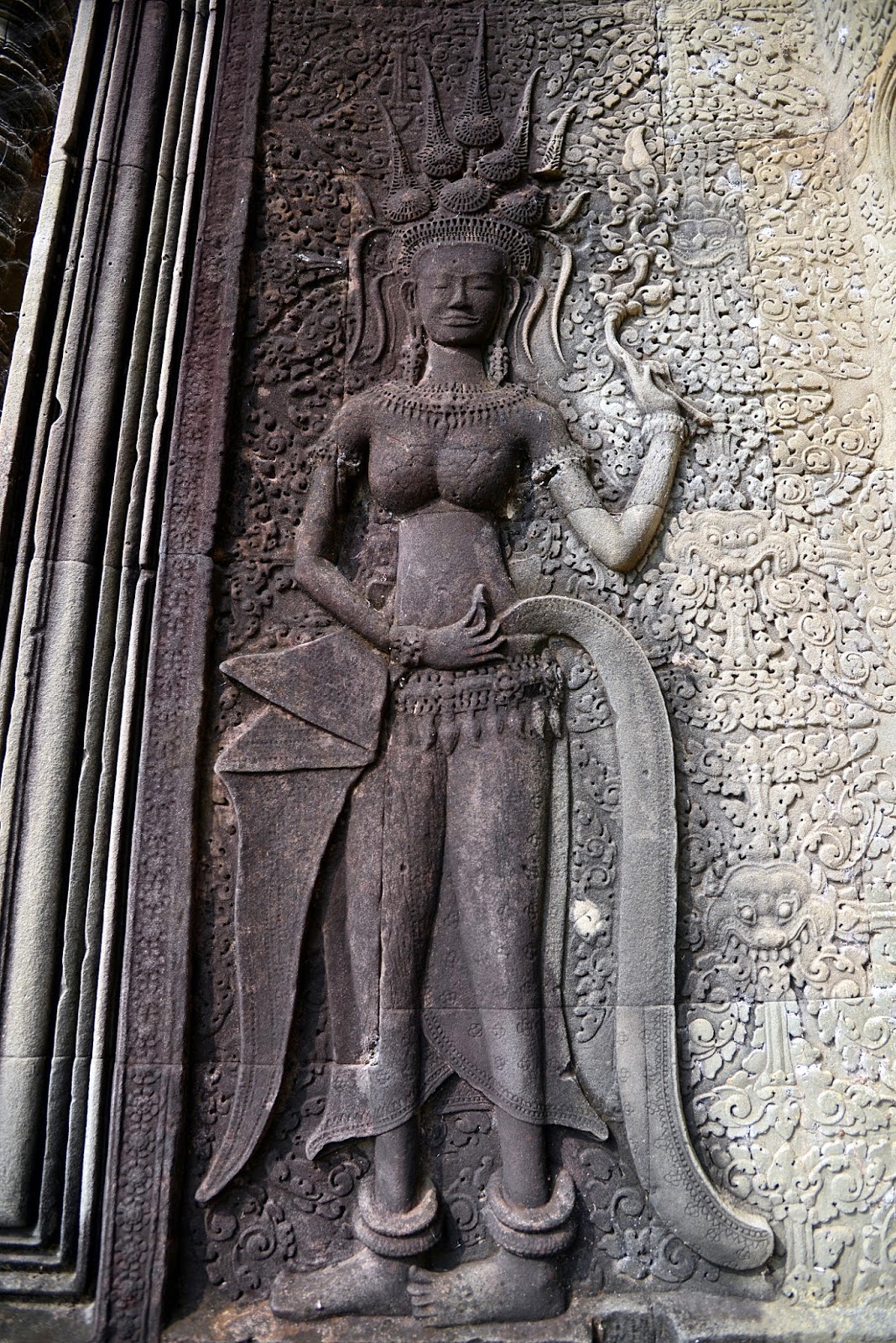
An Apsara (also spelled as Apsarasa) is a female spirit of the clouds and waters in Hindu and Buddhist mythology

Apsaras represent an important motif in the stone bas-reliefs of the Angkorian temples in Cambodia (8th–13th centuries AD), however all female images are not considered to be apsaras. In harmony with the Indian association of dance with apsaras, Khmer female figures that are dancing or are poised to dance are considered apsaras; female figures, depicted individually or in groups, who are standing still and facing forward in the manner of temple guardians or custodians are called devatas 

Apsaras and devatas are beautiful, supernatural female beings

They are youthful and elegant, and apsaras are superb in the art of dancing

Deva is the Hindu term for deity

Apsaras are often the wives of the Gandharvas, the court musicians of Indra

Beautiful threesome

They dance to the music made by the Gandharvas, usually in the palaces of the gods, entertain and sometimes seduce gods and men

As ethereal beings who inhabit the skies, and are often depicted taking flight, or at service of a god, they may be compared to angels

Apsaras are said to be able to change their shape at will, and rule over the fortunes of gaming and gambling

Love these smiling Devatas. I'm seduced!

English translations of the word "Apsara" include "nymph," "celestial nymph," and "celestial maiden"

While women and goddesses appear as icons in many ancient and modern societies, the Khmers gave sanctified women dominance over their state temples more consistently and more visibly than any other group

Pyramid of gods

Lovely pillar

Guardian elephants

Work of art

Devatas often occurred in Hindu epics such as Ramayana and Mahabharata, and also some Buddhist holy scriptures

Every human activity has its devata, its spiritual counterpart or aspect

Dancing!

Bas reliefs from Angkor Thom


Sunday, December 02, 2012

Two Palaces and a Temple in Seoul, S.Korea

Welcome to my final blog of my trip to South Korea. This amazing tree can be found at the Jogyesa Temple

Jogyesa is the chief temple of the Jogye Order of Korean Buddhism

The temple was first established in 1395, at the dawn of the Joseon Dynasty; the modern temple was founded in 1910

Changdeokgung Palace 창덕궁 was the second royal villa built following the construction of Gyeongbokgung Palace in 1405. Here you can see Donhwamun Gate - the main palace gate. Built in 1412, Donhwamun has a two-story pavilion-type wooden structure, and is the largest of all palace gates. Donhwamun was burned down during the Japanese invasion of 1592 and was restored in 1608

Changdeokgung was the most favored palace of many Joseon princes and retained many elements dating from the Three Kingdoms of Korea period that were not incorporated in the more contemporary Gyeongbokgung. This is Injeongjeon, the throne hall. It was used for major state affairs including the coronation of a new king and receiving foreign envoys

One element not incorporated in the more contemporary Gyeongbokgung is the fact that the buildings of Changdeokgung blend with the natural topography of the site instead of imposing themselves upon it

Like the other Five Grand Palaces in Seoul, it was heavily damaged during the Japanese occupation of Korea (1910-1945). Currently, only about 30% of the pre-Japanese structures survive. As you can see the buildings are spectacular

The architectural style of Changdeokgung overall features simplicity and frugality because of Confucian ideology

Gorgeous ceiling

Changdeokgung was added to the UNESCO World Heritage List in 1997

A beautiful Palace and a fun playground for children

Simplicity

It's definitely true that the Changdeokgung Palace is less imposing and has a different atmosphere to the Gyeongbokgung

Beautifully designed window

A cute little visitor to the Palace

Perfect

Adjacent to the Changdeokgung Palace, is another Palace called Changgyeonggung. Originally the Summer Palace of the Goryeo Emperor, it later also became one of the Five Grand Palaces of the Joseon Dynasty. Unbeknown to me these ladies were here for a special occasion

I was fortunate to witness and take some photographs of this special occasion for a Korean husband and wife

This day was their 50th wedding anniversary....

....and they came suitably attired....

....in beautiful traditional costume

The daughter of the couple had arranged this so they would have lovely memories

It was a little stressful and formal for them posing for the photos but this smile says it all

The entrance to the Changgyeonggung Palace called Honghwamun. It is now sunset and time for me to start preparations for my journey back to Singapore

As I was leaving I was fortunate to bump into this little bundle of fun!

Sunday, March 27, 2011

Temples of Phnom Penh

Hi and welcome.

This is the penultimate posting of Cambodia. It is very famous for the incredible ancient temple complex of Ankor. But there are also some lovely, modern, temples and I will show you some shots from three of them; all situated in Phnom Penh.

I hope you enjoy them. The weather was fantastic for showing them off at their best. Next time, the grand finale, Angkor Wat itself.

The Royal Palace is, as the name suggests, the
official residence of the King of Cambodia. In
Khmer its full name is "Preah Barom Reachea
Vaeng Chaktomuk". This lovely building is
the Royal Throne Hall


This is the Hor Samran Phirun, "the Pavilion
where one sleeps peacefully". It is used to
house musical instruments and procession
implements. It is where the king rests and then
mounts an elephant for Royal processions.
It was built in 1917


Chanchhaya, or, also known as Moonlight, Pavilion.
It is used for Royal banquets and as a venue for
the Royal dancers.


Back to the Royal Palace. It is used as an audience
hall, for coronations and diplomatic meetings


Built from east to west the best
time to visit and take photos is
early morning. There's also more
of a chance that there will not be
too many other visitors.


The lady behind the veil. I'm talking about
the building, not the lady peeking behind
the veil; that's my wife!


This is what she was looking at, the Napoleon 111
Pavilion. Somewhat in contrast with all the other
buildings, this was the very first permanent structure
on the site. It was built for Empress Eugenie of France,
the wife of Napoleon 111 in 1876. Napoleon gifted it
to the King of Cambodia.


This is my Empress, Daniela


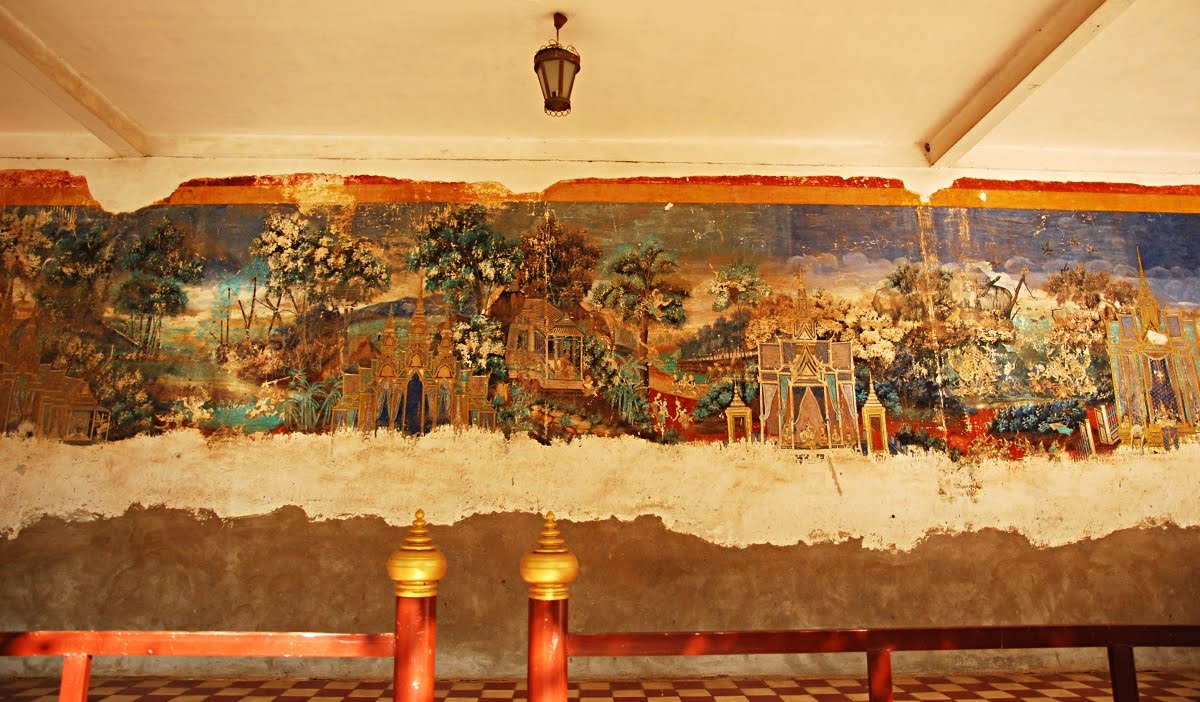
Very old and somewhat damaged frescoes. But
still very beautiful


The belfry, used to signal
the opening and closing of the
temple as well as during ceremonies.
It is in the Silver Pagoda part of the
Palace


The stupa of King
Ang Doung, 1845 - 1860


Reflections


The stupa of Princess
Kantha Bopha. She was the
daughter of the former King
Sihanouk. Tragically she died
aged only four from leukaemia


Final photo of the Palace shows
Wat Preah Keo Morokat. This
is the Silver Pagoda that houses
the Emerald Buddha 5329 silver tiles
cover the floor. It is full of precious objects,
many of which were donated by important
Buddhists.


I went to the Killing Fields of the Khmer Rouge
at Choeung Ek, just outside Phnom Penh. This
building is the memorial stupa to all those who
died during the genocide. I have included it
because it is a temple for the victims to rest
and be at peace according to Cambodian tradition.


This is Wat Ounalom. It is the most important
Wat of Phnom Penh and is the centre of Buddhism
in Cambodia. It was established in 1443 and is
believed to contain, in a stupa, an eyebrow hair of
the Buddha


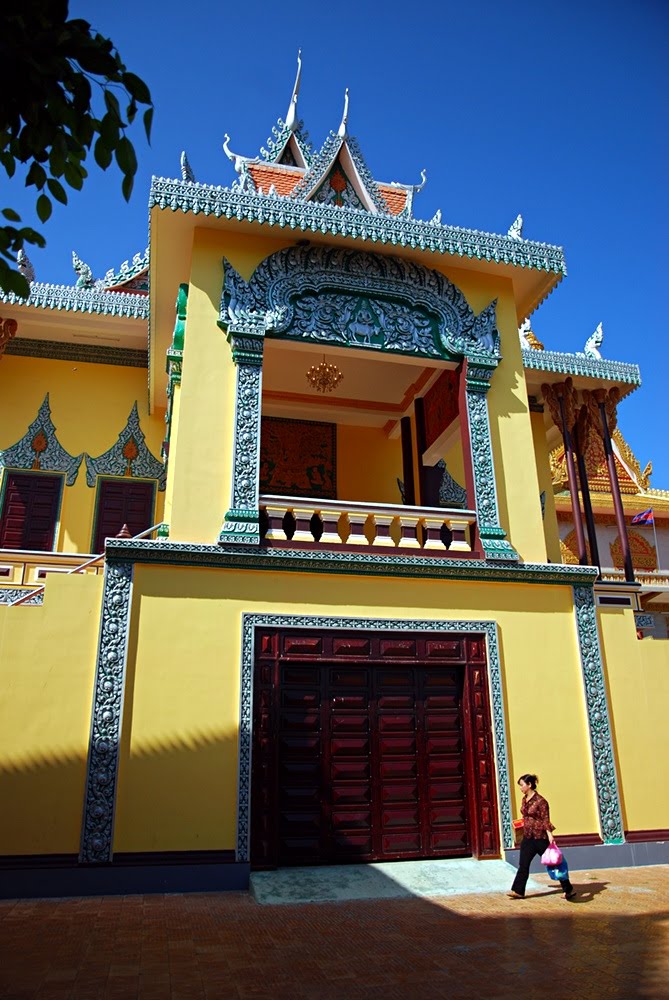
Beautiful architecture


I'm not sure of the significance of this statue
but I loved its setting, nestled in the greenery


Another gorgeous roof


This is the most decorated-with-lights altar
that I have seen and photographed!


One of the main buildings


Fantastic gateway


Exit to the road and riverfront (Tonle Sap river)


I don't think he drinks the beer! Temple elephant
at Wat Phnom


It is known as the Temple of
the Mountain. It stands at 27
metres and was built in 1373
This is the shrine at the bottom
of the main Stupa


The altar inside the main hall, richly decorated


Proud lions, I think they are lions. They are
very stylised


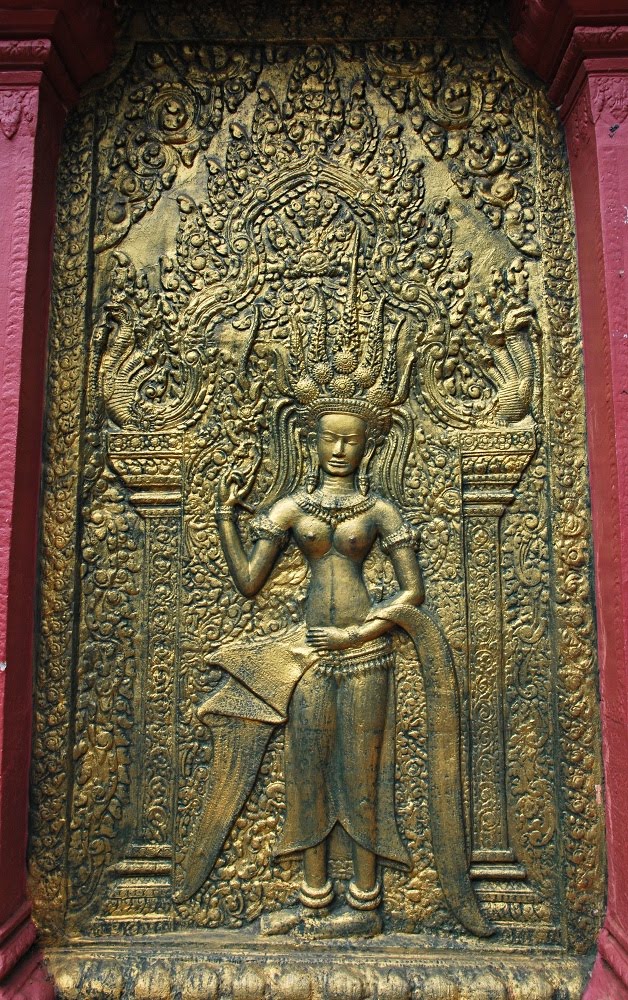
Apsaras, celestial maidens, heavenly beings


Parking place for the birds in
cage 3!


Classic depiction of an apsara

Do come back for Angkor Wat.